Free Ebook
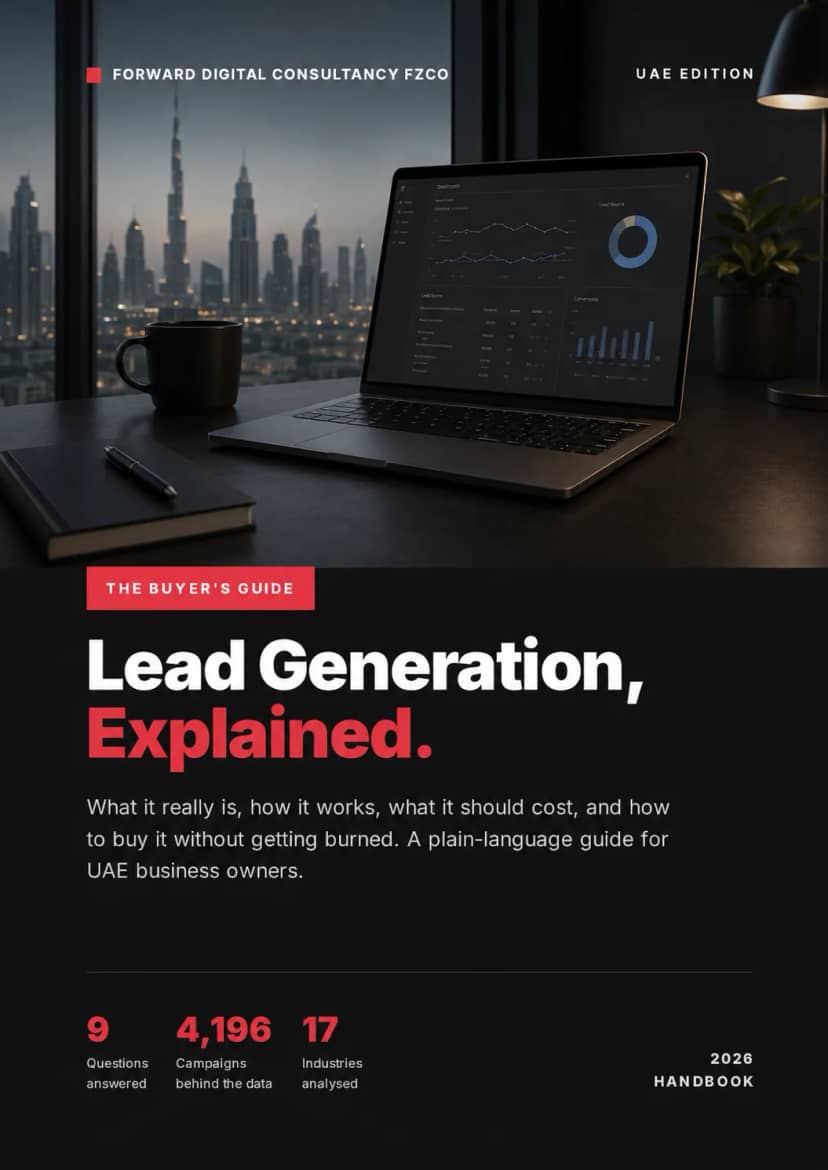
Lead Generation, Explained
The plain-language buyer's guide for UAE business owners
If you have ever paid for "leads" and wondered where the money went, this guide is for you. It answers the nine questions business owners actually ask before they spend a dirham on marketing, in plain language, with numbers drawn from real campaigns rather than theory.
What's inside
- What a lead actually is, and how to tell a real one from a vanity one
- Why lead generation beats chasing reach and impressions
- The five-stage funnel every campaign moves through
- How B2B and B2C lead generation differ, and why mixing them up costs money
- What a lead generation landing page needs to convert
- How to automate follow-up so leads stop leaking
- What lead generation actually costs in the UAE, and what drives the price
- The five metrics worth tracking, and what each one is telling you
- How to decide between hiring an agency and building in-house
Free Download
Get Your Free Copy
Fill in your details below and we'll unlock your free download instantly.
Why this guide exists
Lead generation is the most misunderstood line item in a marketing budget. Business owners get sold "leads" with no agreement on what a lead even is, no view of what it should cost, and no way to tell whether they are being served or fleeced. This guide fixes that. It walks through the nine questions every owner should be able to answer before signing with anyone, written so a non-marketer can follow every word.
What's behind the numbers
The figures in this guide are not borrowed from blog posts. They come from Forward Digital's own campaign data: 4,196 campaigns run across 17 industries. Where the guide cites a benchmark or a pattern (the click-through gap between search and social, the cost creep on stale campaigns, the audience effects on cost per lead), it is reporting what that data actually shows, stated in plain terms without the jargon.
Who this is for
Owners, founders, and managers at UAE businesses who buy marketing but do not live inside it. If you approve the budget, sign the contract, or judge the results, but you are not the one running the ad accounts, this guide gives you the language and the benchmarks to ask better questions and spot a weak partner early.
Want to see your own numbers?
Our team works with UAE businesses to put these exact principles to work. A 30-minute call, your funnel, your numbers, no pitch deck.
Book a free strategy session →Frequently Asked Questions
Answers to the questions buyers actually ask
What is lead generation, and what counts as a lead?
Lead generation is the system that turns a stranger's attention into permission to follow up, on purpose and at a cost you can measure. A lead is a person who has shown enough interest to hand over a way to reach them. The word gets stretched until it means nothing: a like is not a lead, a page view is not a lead, and a phone number typed in by someone who only wanted a free brochure is, at best, half a lead. A real lead asked for something tied to buying, gave accurate contact details, matches who you actually sell to, and expects to hear from you. A vanity lead clicked and vanished, or entered a fake number, or sits in the wrong country and budget. You pay for both the same way, but only one turns into revenue, which is why the goal is never the lowest cost per lead. It is the lowest cost per qualified lead.
Why does lead generation beat chasing reach?
Reach tells you how many people saw you. Lead generation tells you how many raised their hand. Only one of those pays salaries. Impressions, followers, and views feel like progress and look good on a slide, but attention without intent is just noise you rented. The factor that decides whether a campaign works is not how many people you reached. It is what they were trying to do at the moment they saw you. In Forward Digital's campaign data, search ads run three to four times the click-through of social for comparable offers, and high-intent business categories clear seven percent, because the person searching has already decided they want something. The takeaway is not that search wins and social loses. Search captures demand that already exists; social creates demand among people who were not yet looking. A serious plan uses both and picks the channel by the buyer's intent.
How does lead generation actually work?
Every working system, whatever the industry, moves a person through the same five stages. First attention: a stranger sees your offer. Then interest: they click to learn more. Then capture: they hand over their details. Then qualify: you confirm they are a real fit. Then convert: they become a customer. The mistake almost everyone makes is pouring money into the first stage while ignoring the last two. You can buy all the attention you want, but with no system to qualify and follow up, the leads leak out of the bucket faster than you fill it. The single most controllable lever in the whole funnel is speed to first response: a lead contacted within minutes behaves like a different person than the same lead contacted the next day, because the interest is perishable.
What is the difference between B2B and B2C lead generation?
They share the same funnel shape and almost nothing else. B2C buying is fast and often emotional, one person decides, volume is high and the value per lead is lower, and social and discovery channels do the heavy lifting. B2B buying is long and considered, often runs for months, a committee decides rather than one person, volume is lower but the value per lead is far higher, and search and proof-driven content do the work. The practical consequence is in how you measure success. A B2C campaign can be judged in days. A B2B campaign judged on the same timeline looks like a failure because the buyer is still circling. The common, costly error is running a B2B offer with B2C expectations: asking "why so few leads this week" when the buying cycle simply has not finished. Judge B2B on pipeline quality, not weekly lead count.
What does a lead generation landing page need?
The page where the lead is captured does more work than the ad that sent them there. A great ad pointed at a weak page is money set on fire. A landing page has exactly one job, to convert a click into a contact, and the pages that perform share the same bones. One promise, repeated: the headline must match the ad that brought them. One action: remove the navigation and the "explore more" and give them a single thing to do. A short form: every extra field costs you leads, so ask only for what you need to follow up. Proof in view: a number, a result, a recognisable logo. Speed: a page that loads slowly on a phone loses people before they read a word. And a reason to act now. There is a real trade-off on form length: fewer fields mean more leads but lower quality, more fields mean fewer leads but better quality, and the right answer depends on whether your sales team is starved for volume or drowning in junk.
How do you automate lead generation?
Automation does not replace good marketing. It removes the gap between a lead raising their hand and a human responding, which is where deals quietly die. When a lead comes in at 11pm and nobody sees it until morning, the interest has cooled; when the same lead gets an instant reply and a clear next step, the conversation stays warm. A sensible automation stack handles four jobs: instant acknowledgement so the lead knows they reached a real operation, routing so the lead lands with the right salesperson rather than a shared inbox nobody owns, follow-up sequences so a quiet lead still gets a planned series of nudges, and clean records so every lead and outcome is logged and you can see what is leaking. The honest warning: automation amplifies whatever you already have. Automate a strong process and you scale results; automate a broken one and you scale the mess faster. Fix the workflow first, then wire it up.
What does lead generation cost in the UAE?
The honest answer is that it depends, but here is what it actually depends on, so you can judge any quote you are given. Cost per lead is not a fixed price tag; it is an output of several factors. Who you target: audience type can swing cost per lead more than the country you advertise in, and a narrow, high-value audience costs more per lead and is usually worth it. How premium the offer is: luxury framing carries a real premium, and in Forward Digital's data, premium positioning can multiply cost per lead several times over versus a mainstream offer in the same market. How fresh the campaign is: brand-new ad accounts run more expensive for the first month or two before they settle. And how long the creative has run: campaigns that are never refreshed get more expensive on their own, with cost per lead drifting up by roughly a third between a campaign's early and later stages as the audience tires of the ad, which is why a creative refresh every few months is cost control, not a luxury. As for the agency fee itself, separate from the ad budget, a credible UAE retainer covering both search and social management generally starts in the mid four figures per month in dirhams and rises with scope. Anything far below that usually means something is being cut.
What marketing metrics should I actually track?
You do not need the whole dashboard. You need five numbers and an understanding of what each one is quietly telling you. Click-through rate: of the people who saw your ad, how many clicked. A weak number here means the message or the audience is wrong, so fix it before touching anything downstream. Conversion rate: of those who clicked, how many became a lead. This is a verdict on your landing page. Cost per lead: what you paid for each contact, useful only when you also know the quality, because a low cost per lead full of junk is worse than a higher one full of buyers. Return on ad spend: for every dirham spent, how much came back as revenue. This is the number that matters to the bank. And qualified lead rate: how many of your leads were genuinely worth the sales team's time, which is the number that separates marketing that feels busy from marketing that pays. Read the five together, never alone, because each one in isolation can be gamed or misread.
Should I hire a marketing agency or build lead generation in-house?
There is no universal answer, only a clear way to decide, and it comes down to volume, speed, and what your time is worth. Build in-house when lead generation is your core, forever advantage, when you have the volume to keep a specialist busy, when you can afford the six-to-twelve-month learning curve, and when you want the knowledge to live inside your walls. Hire an agency when you need results in weeks rather than quarters, when you want proven systems on day one, when you would rather not manage hiring and tools, and when you value an outside view that has seen many markets. Whichever route you choose, judge the work the same way and ask the same questions: Can you show results in my industry with real numbers? How do you define a qualified lead and how do you measure it? What happens to a lead in the first five minutes after it arrives? What do I own if we stop working together? The tell is simple. A strong partner talks about qualified leads and revenue; a weak one talks about likes, reach, and impressions. Listen for which language they reach for first.
Get the full guide as a designed PDF, delivered to your inbox.
Download the free PDF →